
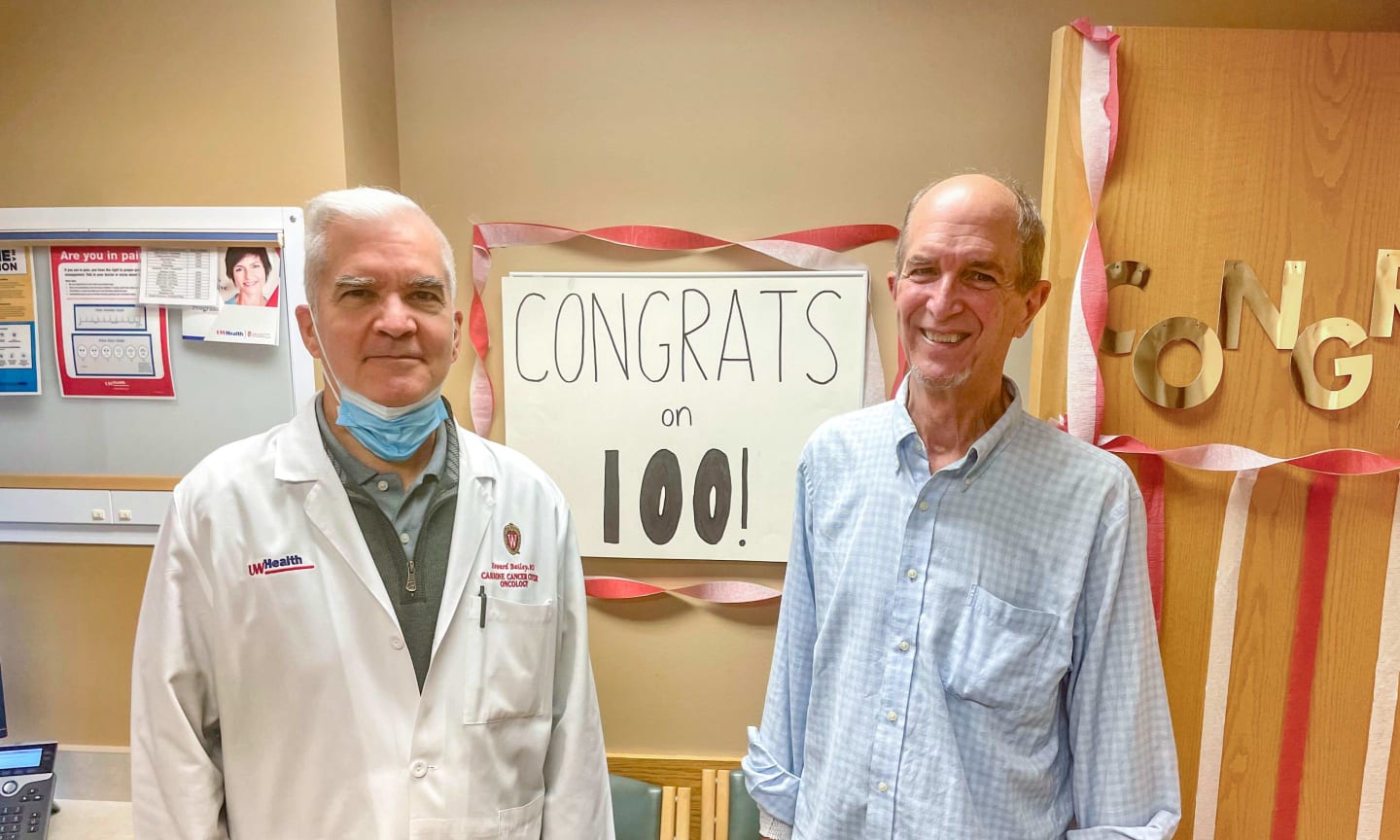
Doug White hit a significant treatment milestone more than 13 years after he was first diagnosed with a rare form of sarcoma.
In September, White received his 100th infusion of immunotherapy as part of a clinical trial he began at UW Health | Carbone Cancer Center in 2016. At that time, his cancer had become metastatic and there were no other approved treatment options left.
“In the time since I started the immunotherapy, there has been no measurable growth in my tumor,” he said.
White was initially diagnosed in 2011 with a chordoma — a rare form of sarcoma that affects the spine and base of the skull. The National Cancer Institute estimates that one in one million people are diagnosed with chordoma per year worldwide.
White underwent a day-long surgery with a team of neurosurgeons at UW to remove his tumor, and he had additional radiation treatments and specialty care at another facility. After his initial care, it was not expected that his cancer would recur. However, X-rays for a shoulder injury in 2015 showed new growth of the chordoma in his shoulder.
Dr. Howard Bailey, a medical oncologist specializing in sarcomas and former director of Carbone Cancer Center, said White’s form of chordoma has been more aggressive than typical and became metastatic by spreading outside of his central nervous system.
Fortunately for White, he was a candidate for a clinical trial in 2016 testing a targeted immunotherapy treatment. His tumor had genetic characteristic that investigators believed would make it sensitive to that type of immunotherapy.
The treatment had an immediate benefit. White’s tumor stopped spreading and has not had new growth since. He’s also grateful to not have any noticeable side effects.
Bailey and Jennifer Pleva, a nurse practitioner in medical oncology, have been pleased with how well White has responded to this new treatment approach.
“It's been great to see Doug be able to truly live life and enjoy doing thing that he enjoys,” Pleva said. “It's really encouraging to see people thrive throughout their treatment.”
Especially for patients with rare cancers, Bailey notes clinical trials can be an important resource for new options.
“It greatly underscores the value of trying new clinical research ideas, especially when there isn’t a standard therapy available, plus it provides important information to help others with a similar type of cancer,” Bailey said.
White is also a strong believer in holistic wellness as part of maintaining good health. In addition to his monthly infusions, he exercises, follows a healthy diet, takes care of his spiritual wellness and makes sure to spend time with friends and family.
“There are so many factors that affect well-being, so I try to put all of those in place, and the icing on the cake has been the immunotherapy,” White said. “I have tremendous respect for the team at Carbone — they’re all very supportive, and I’m really appreciative of all of the care that I’m getting.”
Pleva said patients interested in clinical trials can discuss available options with their doctor at any point during their care, as clinical research also includes studying methods of cancer prevention and survivorship care. One patient’s choice can mean significant progress in care and options for many others facing a similar diagnosis.
“Doug's decision to participate in this clinical trial can help many patients for years to come,” she said. “Clinical trials are imperative to new drug development, and we will hopefully learn more about the treatment of these rare tumor types based on the data that has been collected from this clinical trial.”