Aviso
Welcome Beaver Dam patients! For information about the transition to UW Health, please review our frequently asked questions page.Read more
Utilizamos cookies en este sitio para mejorar tu experiencia y nuestras estrategias de marketing. Si continúas navegando sin cambiar la configuración de tu navegador para bloquear o eliminar las cookies, aceptas el almacenamiento de cookies y tecnologías relacionadas en tu dispositivo.Más Información
Welcome Beaver Dam patients! For information about the transition to UW Health, please review our frequently asked questions page.Read more

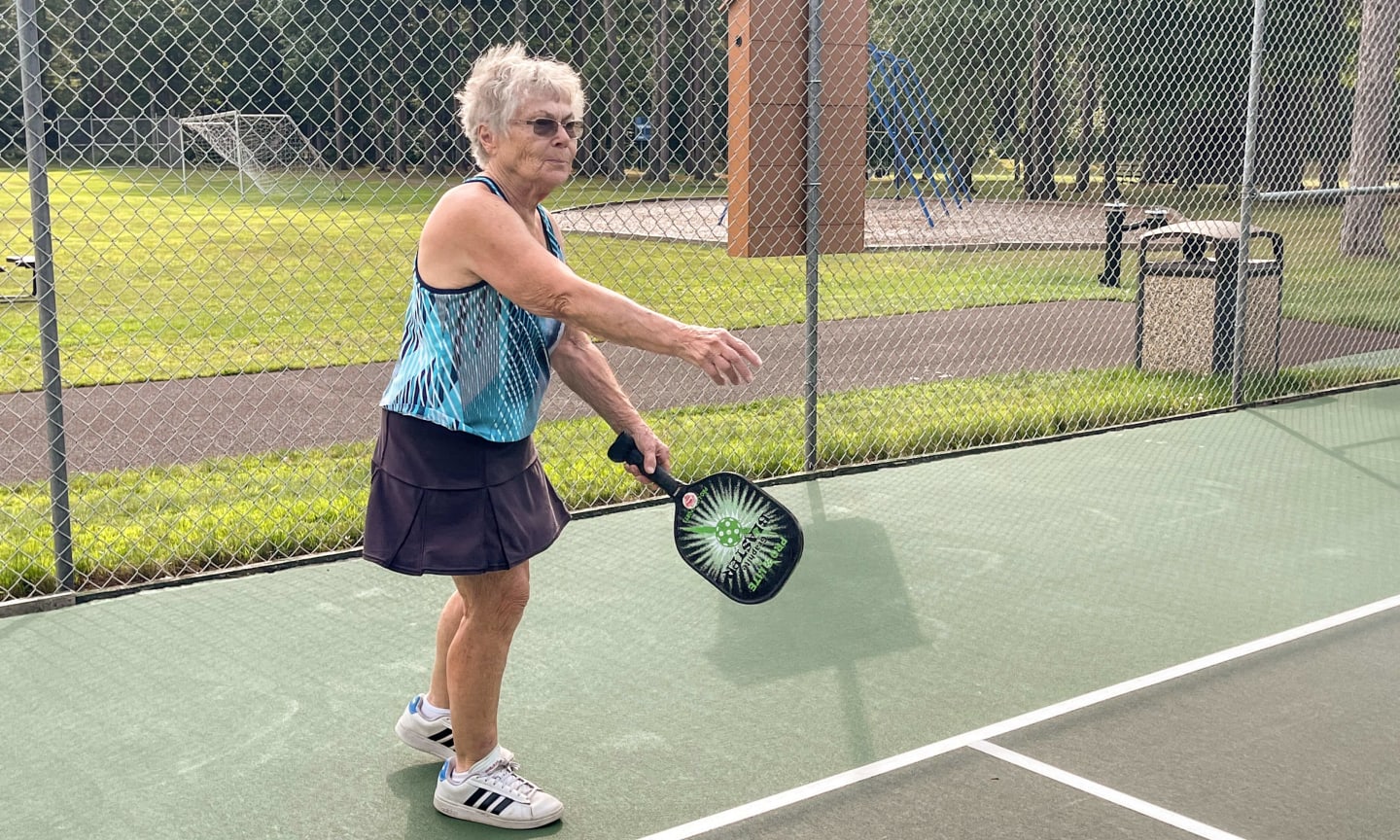
Arlene Kellett spends a large amount of time on her feet. After playing decades of competitive tennis, she transitioned to pickleball, which she plays two or three times weekly. While off the court, she does plenty of yardwork and chores around the house at her Vilas County home in northern Wisconsin. The fact that Arlene is 84 doesn’t appear to slow her down a bit.
Not long ago, however, Arlene’s ability to remain active became limited due to severe pain in her buttocks and lower back. Standing and walking became increasingly uncomfortable. Arlene tried non-surgical treatment, but when the pain came back after several months she wanted a more permanent solution.
She found one at UW Health thanks to the spine surgery team, including Dr. Nathaniel Brooks. Dr. Brooks is among a handful of neurosurgeons trained to perform spine surgery endoscopically — a less invasive approach than conventional spine surgery. The result: Arlene’s recovery was much quicker and less troublesome than it otherwise would have been.
Today, Arlene is back to living her best active life. She's also grateful the incision in her back is just one centimeter — much smaller than would be the case with conventional spine surgery.
Arlene’s pain was caused by a condition called lumbar stenosis, a narrowing of the spinal canal that contains the spinal cord and other nerves essential to body functions.
“As we age, bone spurs emerge in the lower back and start pushing on the nerves,” Dr. Brooks said. “This, in turn, triggers pain — typically in the lower back, buttocks or legs.”
Lumbar stenosis becomes more common with age. About one in 10 older adults will be affected and, because we are living longer, more people are susceptible to this condition, Brooks said.
Doctors usually encourage patients to try non-surgical treatments first because surgery always comes with greater risk, especially for older adults.
Steroid injections provided initial relief for Arlene, but she lives in a small town, four hours north of Madison and the injections need to be administered periodically, so she began to explore more permanent approaches to treatment.
“I spoke with my primary doctor and my neurologist about the endoscopic spine surgery that Dr. Brooks does,” Arlene said. “That sounded appealing to me, especially with the shorter recovery. I had already been through two hip replacements and a knee replacement, so this seemed like something I could deal with.”
After discussing it with Dr. Brooks, Arlene opted for endoscopic surgery in October 2024.
During the procedure, Dr. Brooks uses a thin tool with a light and camera at the end; the entire device is smaller than a Sharpie marker. The device allows him to see exactly what needs to be done through the camera. Instead of cauterizing or burning muscle, he carefully spreads the muscle so he can reach and remove any bone fragments and ligaments that are triggering pain.
“There are many advantages to the endoscopic approach,” said Dr. Brooks, whose partner in neurosurgery, Dr. Bradley Schmidt, also performs microinvasive spine surgery. “Overall, it is much less traumatic to the body. This means less blood loss, less pain, less scarring and less chance of wound infection. Patients also take less pain medication, they go home from the hospital sooner and they recover faster.”
Arlene is grateful to be back on the pickleball court and living without any pain stemming from her lumbar stenosis. She lost her husband in 2015 but relishes the time she spends with her three grown children and five grandchildren.
“Dr. Brooks and his team were wonderful,” Arlene said. “They stayed in close touch with me once I got home from the hospital to be sure I was doing OK. I’ve told several people about Dr. Brooks and am just thrilled to be doing well. God has blessed me, and I appreciate it every single day.”