
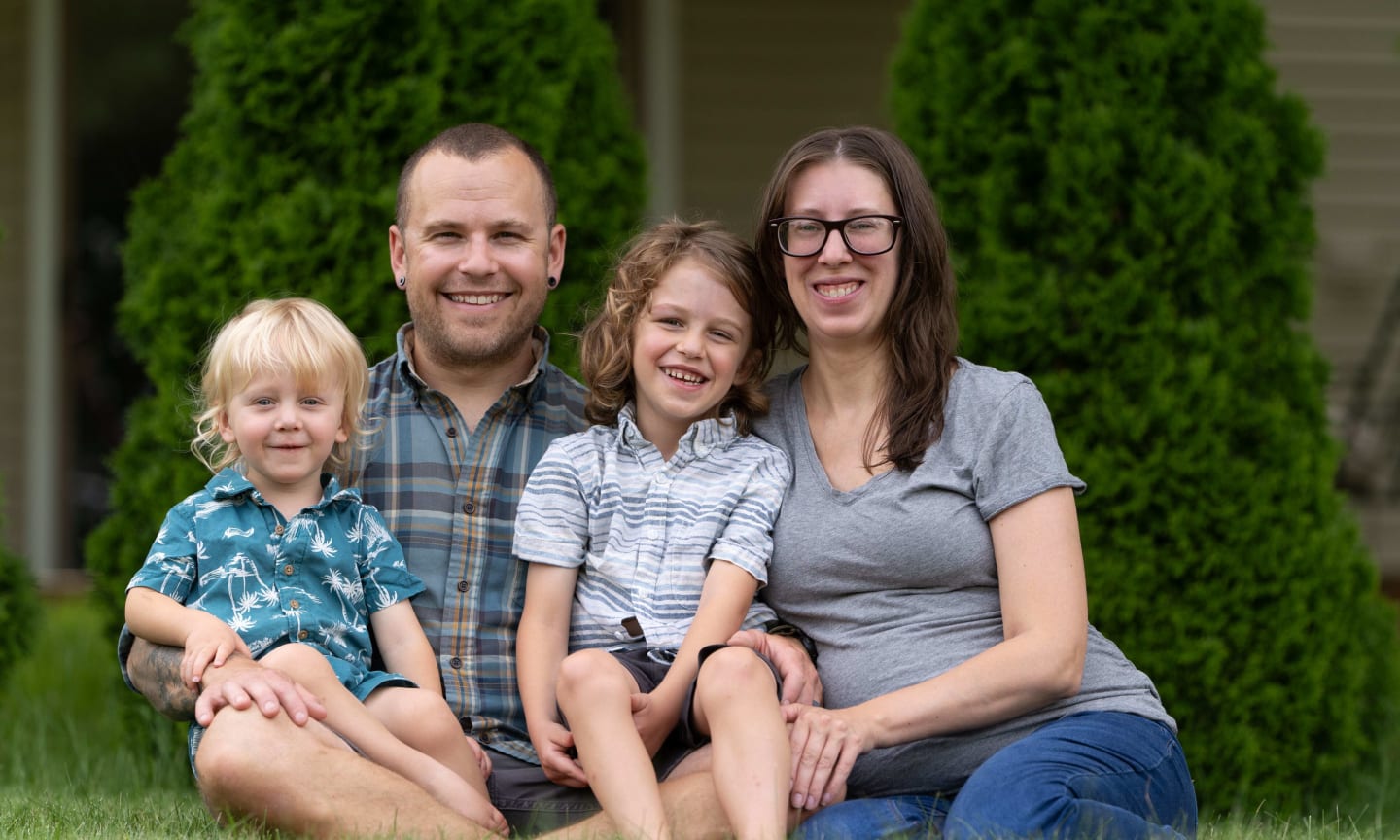
Five-year-old Penn and his little brother Mack, 2, probably have not talked about a rather special bond they have, but they will one day.
These two young Madison boys are among the 90,000 children born in the United States each year with the help of in vitro fertilization (IVF), a medical procedure that can help couples become pregnant after not being able to do so on their own.
More than 2%, or about 1 in 50 children born today are the result of IVF, a technique that involves fertilizing an egg with sperm in a laboratory dish. Hundreds of couples from Wisconsin and beyond, such as Penn and Mack’s parents — Brittany and Kevin Porter — have been able to build their family with the support of It took two rounds of IVF, but Ashley and Brooks McMahon were able to add Whitley to their family - thanks to the experts at UW Health Fertility Care, the clinic that is known for its excellent success rates.
After trying to get pregnant on their own for about 18 months, the Porters came to UW Health Fertility Care in 2017. Brittany, who works for a company that develops new cancer drugs, studied biology and public health in college. She takes a science-based, analytical approach to things and understood that IVF, while often successful, offers no guarantees.
Because most states do not require health insurers to cover the cost of IVF — Wisconsin does not; Illinois does — couples must invest a significant amount of money, time and emotional capital. Aside from the daily injections and frequent clinic visits, the greatest emotional challenge is typically the nine-day wait to learn if there is a pregnancy after the embryo has been transferred into the uterus.
The Porters’ first IVF transfer did not result in pregnancy, but the second one did. Younger women — especially 35 or under — have the best chance of IVF success. Brittany was 32 when she got pregnant with Penn and 36 when she got pregnant with Mack.
Knowing they could have even one child meant so much
“Having Penn was the big hurdle,” Brittany says. “Just knowing that we could have a child with IVF was huge. Our dream was to have two children, but we felt fortunate to have one.”
When Penn was 2, the Porters decided to try for a second. Using two frozen embryos in storage from their original IVF cycle, Brittany underwent two more transfers, but neither resulted in pregnancy.
Eventually, Brittany and Kevin began a second IVF cycle. One of the embryos from this cycle “took” and Brittany ultimately gave birth to Mack.
“The Porters have such a positive attitude and were willing to keep plugging away,” says Dr. Bala Bhagavath, a UW Health reproductive endocrinologist. “Their perseverance is remarkable.”
Those who choose UW Health for fertility care also have the backing of the entire It took two rounds of IVF, but Ashley and Brooks McMahon were able to add Whitley to their family - thanks to the experts at UW Health Fertility Care team, which includes three reproductive endocrinologists, a male infertility specialty trained urologist, three IVF physician assistants, two psychologists, a large nursing team and the embryology lab staff.
The Porters, for example, not only met with all three reproductive endocrinologists, but each of them — Dr. Bhagavath, Dr. Laura Cooney and Dr. Aleks Stanic-Kostic — performed at least one of Brittany’s embryo transfers.
“The clinic is flexible with appointment scheduling and really makes the effort to accommodate you,” says Brittany. “I call the nurse line a lot and they are always available. You never feel like you’re a bother.”
Brittany and Kevin were sure they were going to stop at two children, but they still had one frozen embryo in storage. Moreover, Brittany’s employer added fertility coverage as a health insurance benefit.
The Porters rolled the dice and once again came up pregnant. They are expecting their third child, also a boy, in October 2024.