Aviso
Welcome Beaver Dam patients! For information about the transition to UW Health, please review our frequently asked questions page.Read more
Utilizamos cookies en este sitio para mejorar tu experiencia y nuestras estrategias de marketing. Si continúas navegando sin cambiar la configuración de tu navegador para bloquear o eliminar las cookies, aceptas el almacenamiento de cookies y tecnologías relacionadas en tu dispositivo.Más Información
Welcome Beaver Dam patients! For information about the transition to UW Health, please review our frequently asked questions page.Read more

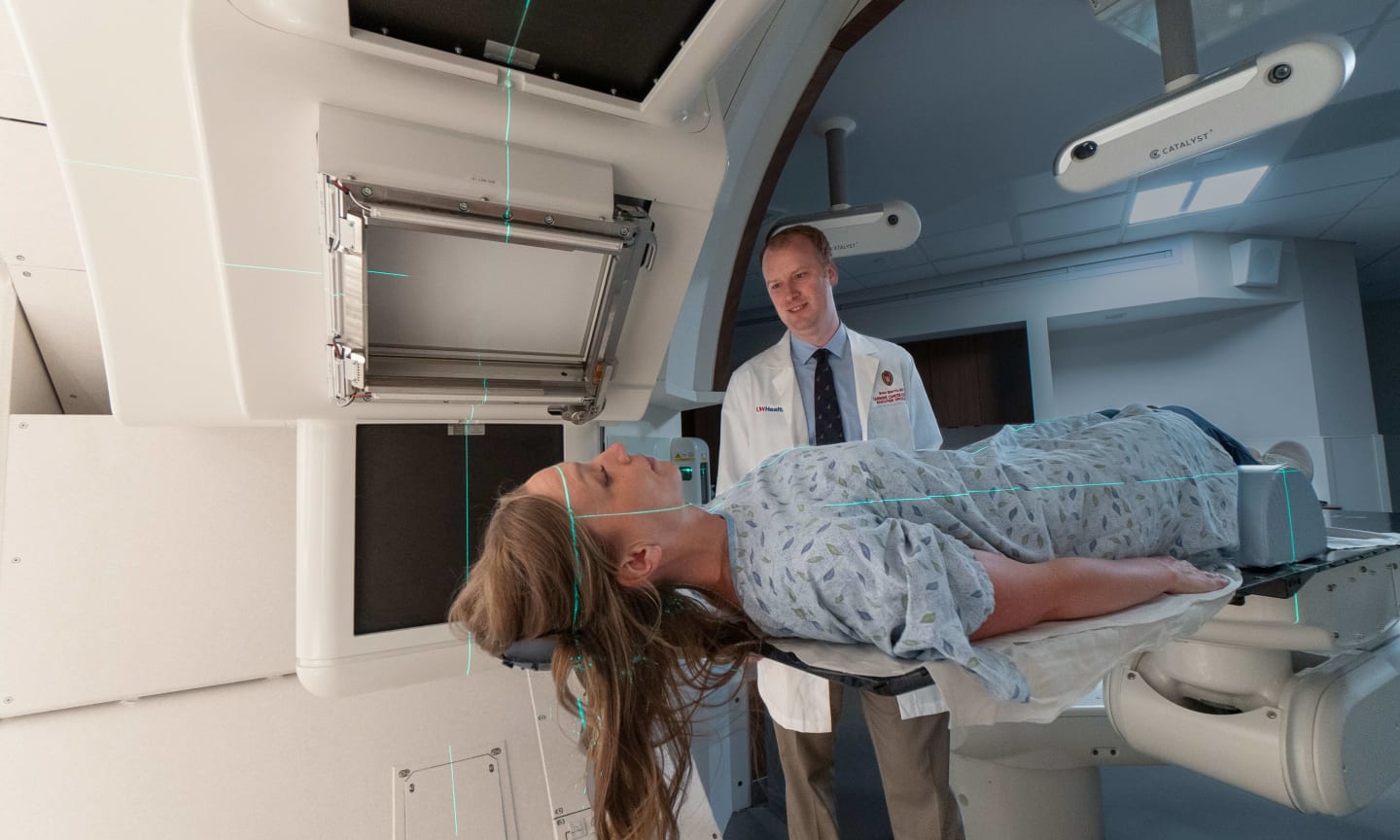
The new Proton Therapy Program at UW Health | Carbone Cancer Center offers a highly precise form of radiation that can be a significant tool in the treatment of select adult and pediatric cancer patients.
Offering proton therapy at UW Health | Carbone Cancer Center has been the culmination of years of planning, fundraising and hard work to bring a cutting-edge cancer therapy to patients in Wisconsin and beyond.
This highly precise method of radiation therapy is a game-changing treatment for select types of adult and pediatric cancers, delivering charged particles directly to a tumor while minimizing the impact on surrounding healthy tissue.
“This technology allows us to personalize radiation treatment with remarkable precision,” said Dr. Ben Durkee, radiation oncologist and medical director of the Proton Therapy Program at the Carbone Cancer Center, and associate professor of radiation medicine, UW School of Medicine and Public Health.
“Less radiation to normal tissue can mean fewer side effects.”
The new Proton Therapy Program, located at Eastpark Medical Center, also expands research opportunities for Carbone scientists. This includes hosting new clinical trials, optimizing methods of delivery, and studying its effectiveness on additional cancer types. This will be further enhanced by the future addition of an upright seated method of delivering proton therapy.
Both traditional beam therapy and proton therapy harness X-ray radiation to treat tumors, but the method of delivery is different.
Dr. Brett Morris, a Carbone radiation oncologist and assistant professor of radiation medicine at UW School of Medicine and Public Health, equates typical beam radiation treatment to a bicycle wheel: the radiation beams are the spokes, and the tumor is the axle. The beams go into the tumor and continue through on the other side.
“Proton radiation is unique in that, while it enters the body, it loses energy as it travels through body, and at the very end it deposits most of its energy at the tumor, and we control within a few millimeters where that radiation stops,” he said.
“The ability to stop that exit dose allows us to avoid any radiation to the most critical structures in the body. For our pediatric patients whose tissues are still developing, all their tissues are critical.”
Like traditional beam radiation, the proton beam is invisible, and the patient does not feel anything during treatment.
Proton therapy is not a one-size-fits-all treatment. Patients should consult with their oncologist about their specific care planning and recommendations.
Proton therapy can be useful to treat several types of adult and pediatric cancers. Especially for child and teen patients, it is important to reduce unnecessary radiation exposure that can lead to negative long-term side effects, including developing secondary cancers.
“We want to preserve a patient’s quality of life for years after treatment,” said Dr. Kristin Bradley, a Carbone radiation oncologist and professor of radiation medicine at UW School of Medicine and Public Health.
Key factors for recommending proton therapy include tumor location in the body and radiation dose needed. If the tumor is located close to critical organs and sensitive body structures, or if a patient has previously been treated with radiation, proton may be particularly valuable.
“If I’ve treated a cervical cancer patient previously and they develop a recurrence within the prior pelvic radiation field, proton therapy can help to be able to deliver additional radiation while reducing the risk for unwanted side effects to the bowel, bladder, and bones,” Bradley said. “Proton therapy can reduce the radiation exposure to normal tissues.”
Proton therapy will not replace traditional beam radiation therapy. Morris said both have their purposes, and in certain cases traditional beam therapy is a better option.
Bradley is excited to have the option of proton therapy in Madison for her patients, who previously needed to travel out-of-state for it. Proton treatments typically are administered multiple days a week over the course of many weeks, so traveling for this therapy can be prohibitive for many patients and their families.
“Previously, they’d be traveling for weeks plus the planning ahead of time (for travel and accommodations),” she notes. “That can be disruptive, especially for families of a pediatric cancer patient. Furthermore, not everyone has the time flexibility and financial means to travel and help maintain life at home.”
UW Health also will become one of the first sites in the nation to offer an exciting option known as upright proton therapy. Traditional proton therapy involves a patient lying flat on a treatment table and rotating a massive proton beam gantry around the patient.
Upright proton therapy keeps the proton beam fixed, and the patient sits in a specialized chair that can rotate them into the appropriate position for treatment. The seated position may be more comfortable for some patients, including those with health conditions made worse by lying flat.
“For some people, lying on their back is not possible, and the possibility of upright positioning may be a better decision for them,” Bradley notes.
Patients interested in learning whether proton therapy may be appropriate for their care should talk with their cancer care team or visit uwhealth.org/proton-therapy.