Aviso
Welcome Beaver Dam patients! For information about the transition to UW Health, please review our frequently asked questions page.Read more
Utilizamos cookies en este sitio para mejorar tu experiencia y nuestras estrategias de marketing. Si continúas navegando sin cambiar la configuración de tu navegador para bloquear o eliminar las cookies, aceptas el almacenamiento de cookies y tecnologías relacionadas en tu dispositivo.Más Información
Welcome Beaver Dam patients! For information about the transition to UW Health, please review our frequently asked questions page.Read more

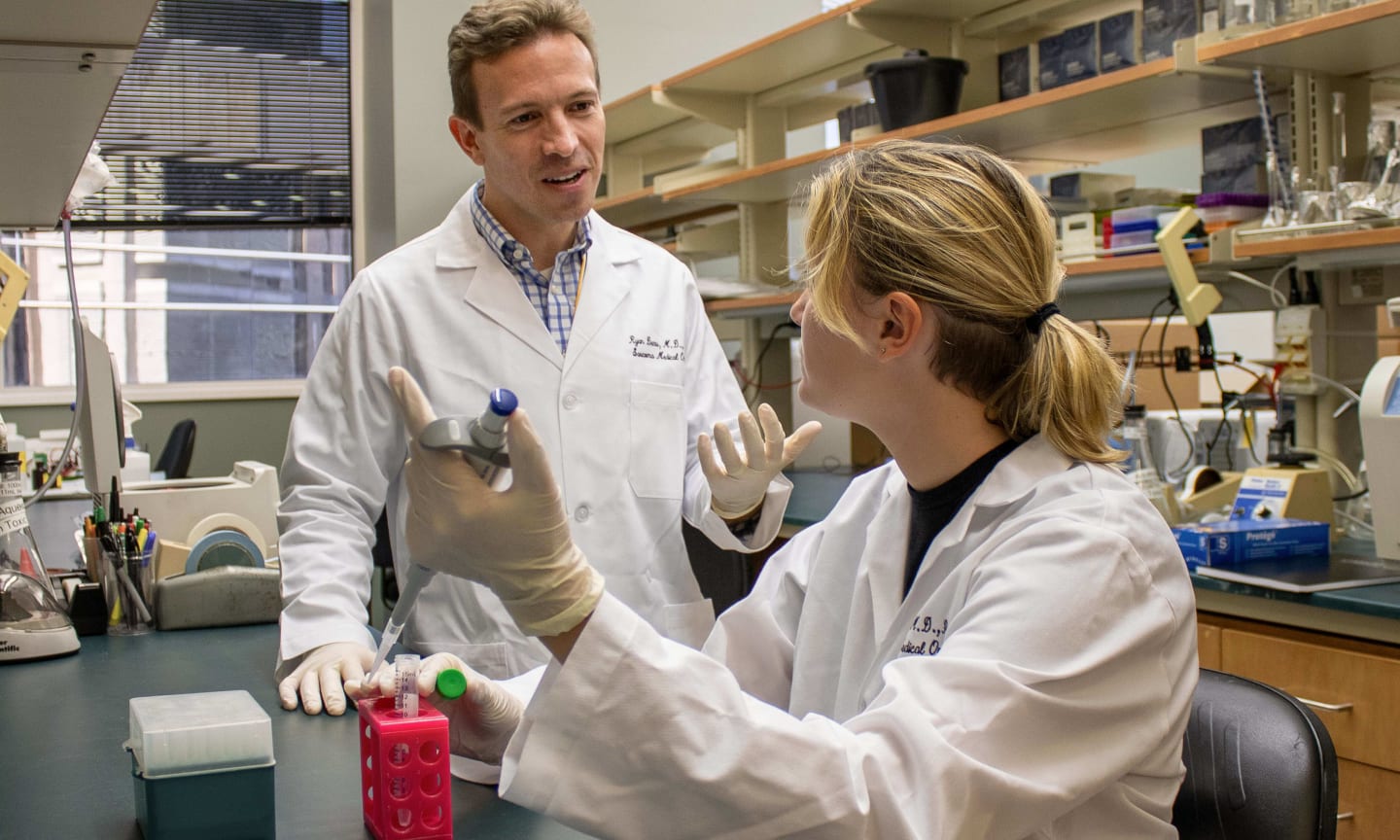
Dr. Ryan Denu is a medical oncologist specializing in sarcomas, a rare group of cancers that form in the body’s connective and supportive tissues. He’s also active in the lab examining sarcoma cell interactions to understand their abnormal gene expression and what drives growth to devise new treatment approaches.
Dr. Ryan Denu treats patients at UW Health | Carbone Cancer Center diagnosed with sarcomas, a rare group of cancers that form in the body’s connective and supportive tissues, like bones, muscles, cartilage and fat.
Understanding the need for better treatments firsthand, Denu is also an active Carbone Cancer Center scientist who investigates the biological processes of how sarcomas form and evolve. His goal is to identify new targets for more precise treatments.
“Our work is highly translational,” said Denu, an assistant professor of medicine at UW School of Medicine and Public Health. “We are very actively engaged in this bench-to-bedside, and back to the bench work to identify the best therapies for our patients, and to learn from them to inform our research experiments and studies in the lab.”
All cells in the body come with the same DNA blueprint. How a cell functions is based on how certain genes within that DNA are activated. Denu said sarcomas form when normal cells begin acting irregularly, taking on traits of different body cells.
“Sarcoma cells have figured out ways, through modifying how different genes (in their DNA) are being expressed, to acquire other characteristics that they're not supposed to have, and that allows them to behave in ways that they're not supposed to behave,” Denu said.
Sarcomas make up about 1% of new adult cancer diagnoses. They are more common in children, making up about 13% of diagnoses in young cancer patients. Sarcomas are most likely to form in a person’s arms, legs, or abdomen, and they have a high risk of spreading to distant sites such as the lungs.
Current standard of care treatments include any combination of surgery, radiation, chemotherapy, immunotherapy, and targeted therapy. When sarcomas become metastatic, treatment becomes much more difficult.
Denu’s lab is focused on three of the most common forms of sarcoma: Leiomyosarcoma, which forms in smooth muscle tissue; liposarcoma, which forms in fat tissue; and undifferentiated pleomorphic sarcoma, which most often affects the soft tissue in the arms and legs.
Using tissue samples collected from patients, Denu’s lab is examining cancer cell interactions to understand exactly what causes their abnormal gene expression and drives cancer growth.
“In learning about that process, we hope to be able to develop new therapies to target the machinery that's driving those processes and exploit that for new sarcoma treatments,” he said.
Denu’s lab has identified a number of different targets already that could be promising, including ones where existing FDA-approved drugs may show potential.
“So we're very excited to kind of see the results of those early phase trials and then to hopefully launch investigator initiated clinical trials that would study some of those pathway inhibitors specifically in sarcoma,” he said.
Denu said his lab also is interested in improving the effectiveness of immunotherapy against sarcomas. Tumor-associated macrophages (a form of white blood cell) embedded within tumors can help it evade immune response, so his lab is exploring ways to help the immune system recognize those tumors again so immunotherapy can work.