
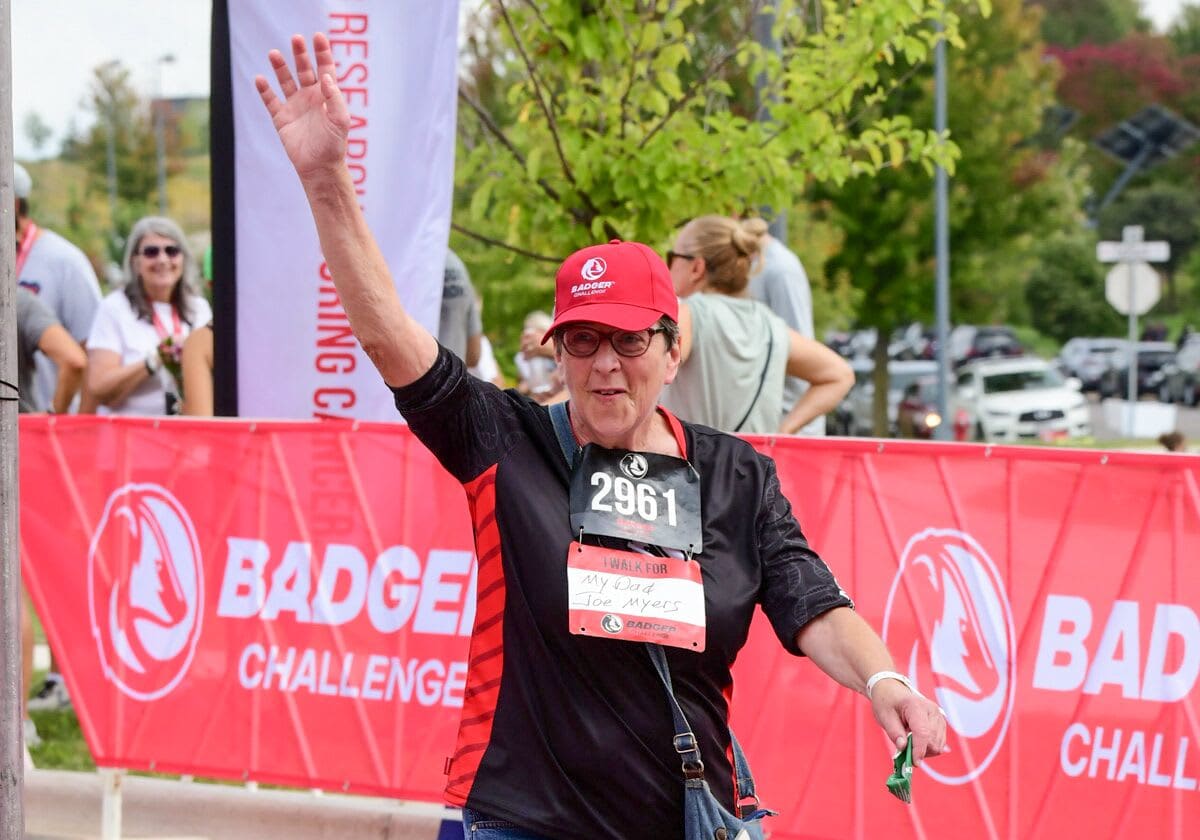
Despite inheriting a rare genetic disorder that has led to decades of specialist visits, the removal of one eye and a kidney cancer diagnosis, Mary Kay Schimming focuses on the blessings in her life and staying active in the community.
“I'm getting great care. I'm telling you, they watch me like a hawk,” Schimming, 67, said of her team of specialists at UW Health. “It’s a lot of appointments, but then I just look at it, you know, they're keeping me alive.”
Schimming, a Madison resident, was born with von Hippel-Lindau syndrome, a disorder that increases a person’s risk of developing benign and cancerous tumors in the eyes, brain, spinal cord, adrenal glands, pancreas and kidneys. National Institutes of Health data estimate the disorder occurs in one in 36,000 births.
Schimming first experienced worsening vision in her left eye while in grade school. Genetic testing confirmed von Hippel-Lindau syndrome, which she later learned she inherited from her father. A military veteran, he passed away at age 33 in 1967 from complications arising from that disorder.
Dr. T. Michael Nork, a UW Health ophthalmologist and professor of ophthalmology at University of Wisconsin School of Medicine and Public Health, has been treating Schimming since 1993. He said the vision issues in her left eye were caused by hemangioblastomas, or noncancerous tumors in the blood vessels of her eye retina. This is a common manifestation of von Hippel-Lindau.
“They’re benign, but only in a sort of ‘finger quote’ kind of way,” Nork said. “They’re not cancerous, but they can take away your vision.”
Schimming had multiple procedures in that eye, including freezing the tumors with cryotherapy and surgery to repair the detached retina. Unfortunately, her eye had to be removed in 2004 and she's worn a prosthetic since.
“It was challenging. It was weird because you even felt off balance,” she said of adjusting to life with one eye. “But I have depth perception in my right eye, you know. You adapt to it.”
The disorder also caused led to Schimming’s kidney cancer diagnosis in 1998. A CT scan showed tumors on her left kidney and she underwent surgery to remove the affected portion. After that, she was monitored regularly for new tumor growth and treated with ablation, or a precision dose of high heat or cold directly to that tumor to destroy it.
Dr. , Schimming’s medical oncologist and a professor of medicine at UW School of Medicine and Public Health, said historically, von Hippel-Lindau patients who develop kidney cancer were treated in the same way as other kidney cancer patients. Then, in 2021, the FDA approved a drug that specifically blocks the protein that causes von Hippel-Lindau-associated tumor growth.
“For patients with von Hippel-Lindau disease, it can have other (anti-tumor) effects even outside of the kidney cancer,” Kyriakopoulos said, noting the drug has since been approved to treat all kidney cancer patients as well.
Schimming has felt good overall since starting that medication and it's kept new cancer growth in check. In addition to her appointments with Nork and Kyriakopoulos, she also sees other specialists at UW Health to monitor for additional health issues from her diagnosis, including regular imaging of her brain and spine.
Nork admires Schimming’s positive mindset and focus on living life to the fullest.
“I enjoy seeing her every six months,” he said. “It’s a thrill to see someone getting past this and she’s survived long enough to benefit from some of the new (cancer) treatments that we now have. It also proves, among other things, that you can have a very full life with one eye.”
Schimming is a caretaker for her mother and stepfather, stays active with her dog, and supports many charities, including Carbone’s cancer research. She also enjoys reading and spending time with her blended family. She did not have biological children, so she’s grateful to have three stepchildren who now have their own children.
“Now I'm blessed with kids and grandkids,” she said. “I never thought I’d have that.”