
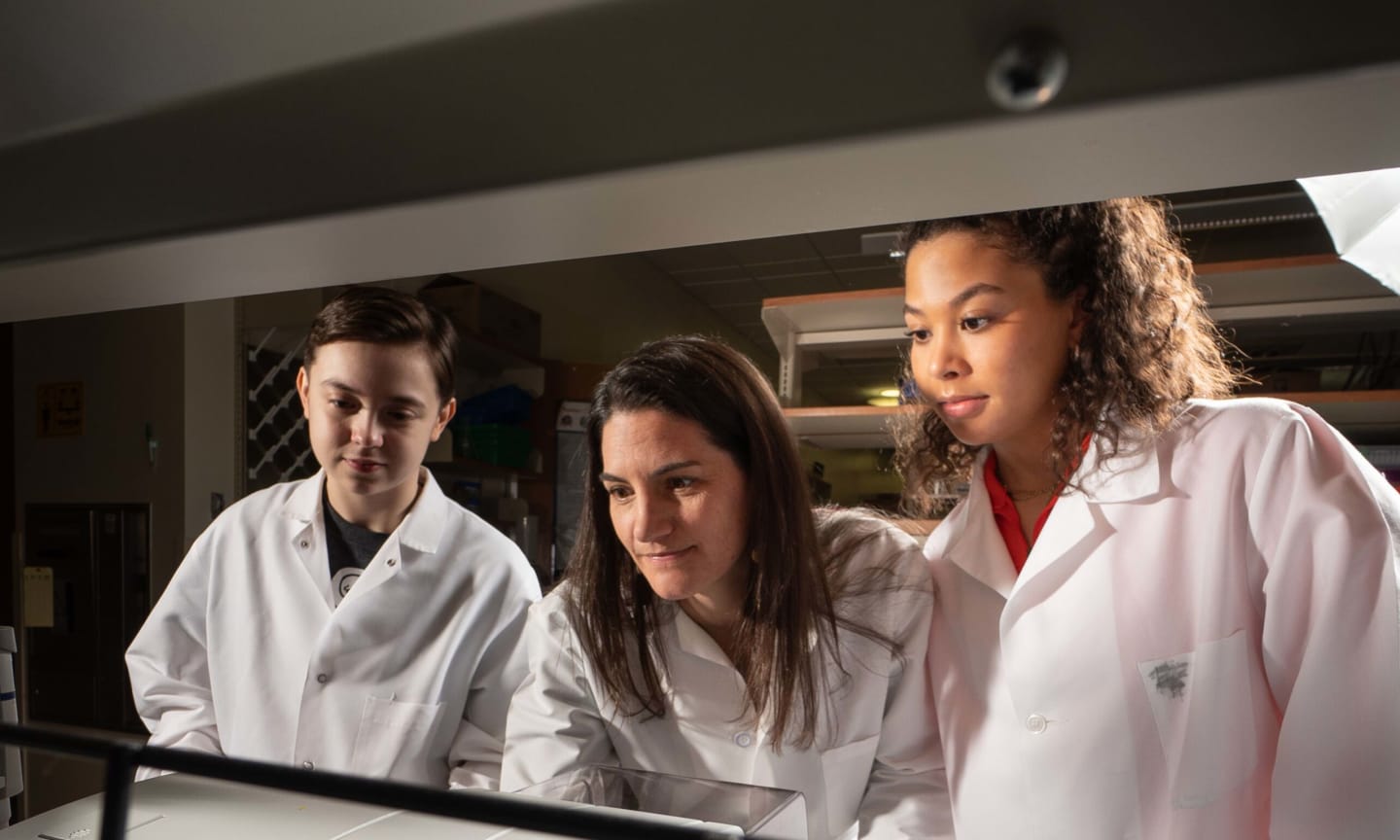
Pediatric cancers are relatively rare, so teamwork among the UW Health | Carbone Cancer Center and other leading cancer research centers has been a crucial catalyst for new treatment breakthroughs for these young patients.
Carbone Cancer Center is among the founding members of the Empowering Pediatric Immunotherapies for Childhood Cancer (EPICC) Team, a partnership among several North American cancer research institutions that combines expertise in immunotherapy and genomics to create precision treatments for the most difficult-to-treat pediatric cancers. The goal is to speed up life-saving discovery and make best use of limited funding by sharing resources and knowledge across several top research centers.
“We’re seeing progress, and in many ways the progress is not a single breakthrough but based on many small steps taken by teams working together and putting small steps together into ultimately big improvements in clinical care,” said Dr. Paul Sondel, a professor of pediatric oncology at the UW School of Medicine and Public Health.
These efforts are led at UW by Sondel and Dr. Christian Capitini, pediatric oncologist at Carbone and division chief of hematology, oncology, transplant, and cellular therapy at UW School of Medicine and Public Health.
Neuroblastoma
Sondel is developing new treatments for neuroblastoma, a form of cancer that affects immature nerve cells. He and Amy Erbe-Gurel, PhD, a research assistant professor in his lab, collaborate with Dr. John Maris at The Children’s Hospital of Philadelphia to understand the genetic variations in neuroblastoma that lead to more treatment-resistant subtypes so they can develop new treatments to overcome that.
He and Erbe-Gurel are also innovating a more precise treatment that avoids the painful side effects of current standard of care immunotherapy for neuroblastoma. Patients now are treated with immunotherapy that targets a cell feature, called GD2, shared by both healthy and cancerous nerve cells. Sondel and Erbe-Gurel are developing a new immunotherapy, called SNIPER mAb, that requires both GD2 and another cancer-specific feature, called B7H3, be present to initiate the immune system response. That way, healthy nerve cells are spared.
Brain cancer
Capitini specializes in developing cell therapies that leverage the body’s own immune cells to fight cancer. CAR T-cells are white blood cells drawn from a patient that are modified to overcome the immune system defenses created by cancer cells. This treatment has been extremely effective in most blood cancers, but there are hurdles to their use in solid tumor cancers.
Capitini is collaborating with Matt Forsberg, PhD, a scientist in his lab, Krishanu Saha, PhD, a professor of biomedical engineering at UW, and Dr. Jacques Galipeau, director of the UW Program for Advanced Cell Therapy, to engineer CAR T-cells that are able to attack solid tumor cancer cells. Their approach uses CRISPR, or precision editing of genes in DNA, to create a more uniformly effective batch of CAR T-cells that stay fit enough to penetrate solid tumor cancer cells and rally an ongoing immune system response. He is preparing this approach for clinical testing for both pediatric and adult brain cancer patients.
“The hope is that a single injection can lead to a sustained anti-tumor response,” Capitini said.
Leveraging radiation
Dr. Zachary Morris, a radiation oncologist at Carbone, chair of the University of Wisconsin Department of Human Oncology, and a co-investigator on UW’s EPICC Team, researches new radiopharmaceutical treatments for metastatic cancers, or cancers that have spread throughout the body.
Radiopharmaceuticals are designed to seek out cancer and deliver a precision radiation dose. Morris, Capitini and Sondel have been investigating a combination approach of giving a radiopharmaceutical therapy prior to CAR T-cell therapy to weaken the cancer cells and enhance the attack power of CAR T-cells.
A pivotal factor is finding the right timing between each treatment: Too soon means the remaining radiation could kill the CAR T-cells, and waiting too long would give the tumors a chance to regain their strength and lessen the CAR T-cells’ effectiveness.
“With the correct dosing and timing, you could unleash major synergies that could be potentially curative for a patient,” Morris said. “So that type of personalization, precision and strong foundation of preclinical work is really critical and the core of what we’re doing.”
Acute myeloid leukemia
Dr. Becky Richards, pediatric oncologist at Carbone and assistant professor of hematology, oncology, transplant, and cellular therapy at UW School of Medicine and Public Health, is creating new CAR T-cell treatments for acute myeloid leukemia (AML), which affects the blood-creating cells in bone marrow and leads to abnormal white blood cells.
Developing CAR T-cell therapy for AML has been difficult because of the lack of unique targets on AML cancer cells that aren’t also shared by normal cells.
“CAR T-cells are very effective killers, and we don’t want to put healthy cells at risk, so it’s optimal to go after (a target) that’s really dense on the tumor and hopefully not very dense on any other cells,” she explains.
Richards’ lab is pursuing a CAR T-cell approach that targets the cell feature CD93, but because it is also present in the normal cells that line blood vessels, she’s designing CAR T-cells that also incorporate an “off switch” to protect those healthy cells.