
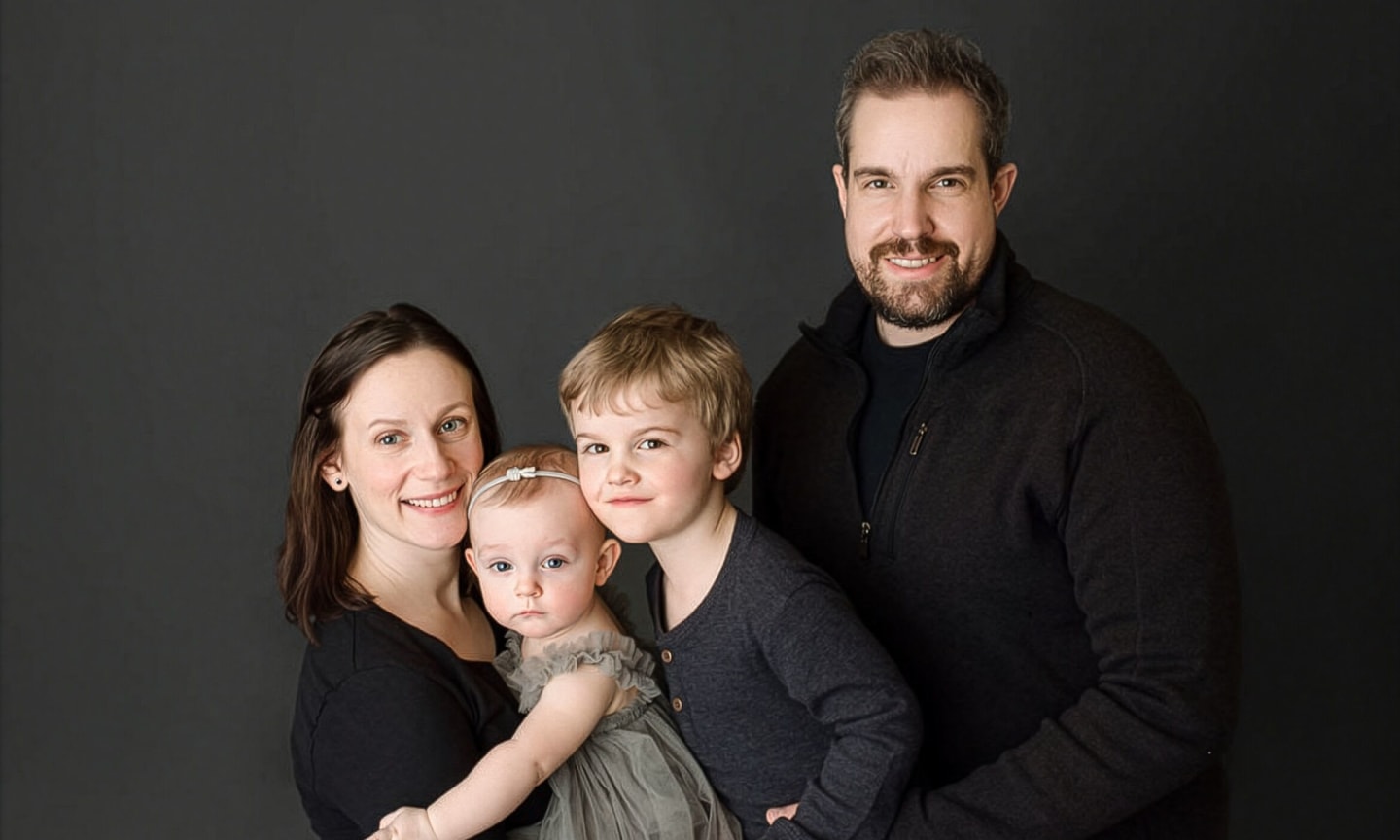
Carolyn and Tim Cooper knew building their family might not be simple. With medical histories that included childhood cancer treatment and polycystic ovary syndrome (PCOS), they understood early on that in vitro fertilization (IVF) could be part of their future.
When they turned to UW Health Fertility Care in Madison, Wis., they found not only advanced fertility treatment, but a care team that took time to understand their full health history, concerns and goals.
“We hadn’t been using protection for the five years we were together, so we had already processed through many of the emotions,” Carolyn said.
Because they were already receiving care within the UW Health system, choosing UW Health Fertility Care felt like a natural next step. The couple had their first fertility appointment in February 2018, four months after they were married in Belize during the height of the Zika virus. After a recommended 90‑day waiting period, they were ready to move forward with IVF.
“We were nervous IVF wouldn’t work,” Carolyn said. “But I was also hopeful. I was 27 and Tim was 30, so we felt like we were starting at a good time.”
Understanding medical factors affecting fertility helped develop a personalized plan
As with many couples, Carolyn and Tim’s infertility involved more than one factor. Tim had been treated for leukemia as a child, and although he was healthy, his prior cancer treatment affected his sperm count and motility. Carolyn’s PCOS meant that while she had a good number of eggs, she did not ovulate regularly.
“One third of infertility issues are related to female factors, one third to male factors, and one third are a combination,” said Dr. Laura Cooney, a UW Health Fertility Care specialist and national expert in PCOS.
“Every case is unique, but IVF can overcome many barriers. I always remind patients that they’re not alone and that we’ve helped others with similar challenges.”
UW Health’s approach focused on addressing both partners’ needs through a coordinated, personalized plan. To overcome male factor infertility, Dr. Daniel Williams, a UW Health urologist, recommended intracytoplasmic sperm injection (ICSI), a embryology laboratory technique in which a single sperm is injected directly into each egg to achieve fertilization.
For Carolyn, the plan included medications to regulate her cycle and stimulate the ovaries to produce multiple eggs. The goal was to obtain enough eggs to create viable embryos while minimizing side effects.
“Our patients are not just a number to us,” Dr. Cooney said. “We work hard as a team to tailor treatment, so it fits their medical history and their lives.”
A successful first IVF cycle
Carolyn and Tim’s first IVF cycle resulted in three embryos. They chose a fresh embryo transfer, which typically occurs within a few days of egg retrieval. One embryo resulted in a successful pregnancy.
Six months later, the couple relocated to Seattle for Tim’s job, where Carolyn delivered their son Eli — a winter solstice baby born in December 2018. They were already planning their return to UW Health in Wisconsin to transfer their remaining embryos, hoping to make Eli a big brother.
Traveling 1,900 miles back to UW Health for care
Plans changed when the COVID‑19 pandemic disrupted travel and health care across the country. Remote work made it possible for Carolyn and Tim to return to Madison for two frozen embryo transfers, neither of which resulted in a pregnancy.
Disappointed but determined, they considered whether to find a fertility specialist closer to home. Ultimately, the decision was clear.
“Even though UW Health was more than 1,900 miles away, we trusted the care and the team,” Carolyn said.
“They did a great job keeping patient care going during COVID and that mattered to us.”
Managing a more complex IVF cycle
When Carolyn returned to UW Health for another IVF cycle, the team reviewed everything that had worked and what could be improved.
“When someone returns for a second baby, we look carefully at prior cycles,” Dr. Cooney said. “Our goal is always to give patients the best chance while keeping them safe.”
Because Carolyn’s ovaries had under‑responded previously, her care team recommended a more aggressive stimulation protocol. This approach led to the retrieval of a significantly higher number of eggs but it also caused ovarian hyperstimulation syndrome, a rare complication that required close monitoring.
With medication, rest and support from her husband, Carolyn recovered. Today, ovarian hyperstimulation occurs far less frequently than in the past — less than 5%, as protocols have become more precise.
“The field has evolved,” Dr. Cooney said. “We’re better at fine‑tuning medication doses and adjusting plans as needed.”
Choosing fresh or frozen embryo transfer can also make a difference. Fresh transfers occur within a week of the egg retrieval, which is appealing to patients as pregnancy occurs sooner. The downside is that hormones from the simulation are still high, increasing the chance of hyperstimulation.
“Our decision to do a fresh or frozen transfer is individualized to each patient case,” said Dr. Cooney. “For Carolyn, we were able to help make her travel to Madison easier by coordinating everything at the same time.”
Because Carolyn and Tim had traveled such a long distance for care, they opted for fresh transfer.
“We did the transfer five days later,” Carolyn said. “Our daughter, Madison, was very active then — and she’s been active ever since.”
Honoring the care team that helped grow their family
Madison was born on Valentine’s Day in 2022 and named in honor of the city and the care team that made her arrival possible.
UW Health physicians are faculty at the University of Wisconsin School of Medicine and Public Health, a reputation Carolyn heard about even while living in Seattle. Several of her family’s physicians, including the OB-GYN who delivered their daughter, had trained in Madison, which reinforced her confidence in UW Health’s experience, expertise and approach to care.
“Once you leave Wisconsin, you realize how much you miss that level of care,” she said. “Being part of an integrated system — where fertility care, obstetrics, pediatrics and adult care are all connected — is something that’s not available everywhere.”
Returning to Wisconsin to be closer to family remains a long‑term goal. When they do, the UW Health teams who supported their journey will be ready to welcome them back.
“At UW Health Fertility Care, we always felt known, supported and confident in the care we were receiving,” Carolyn said. “That made all the difference.”